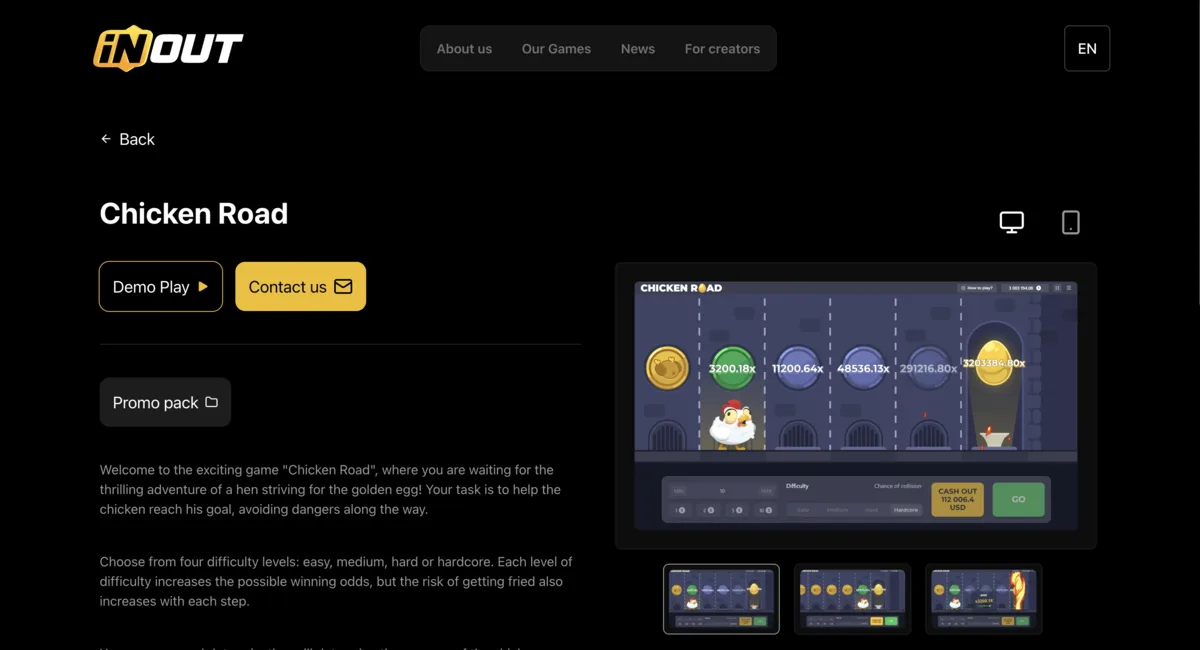
InOut Games - RTP 98%
Lucky Ducky vs Chicken Road
Chicken Road is the closest same-provider benchmark: bright road-risk pacing, a public provider page, and a higher listed RTP.
Open comparisonRTP And Risk
A good Lucky Ducky strategy is not a secret pattern. It is small stakes, short sessions, careful bonus-buy use, and knowing what the 95.5% RTP can and cannot tell you.
Updated 2026-10-12 - 18+ - independent guide

Direct Rule
The practical Lucky Ducky strategy is to control the parts you actually control: stake size, session time, and whether bonus buys are allowed. You cannot force the claw or erase the 4.5% long-run house edge.
Lucky Ducky looks like an arcade cabinet, but it should be treated like a casino game. The claw can make a round feel close or personal, yet the useful decisions still happen before the round starts. For PLay Luck Duck searches, the first strategy step is identity: Lucky Ducky by InOut Games, 95.5% RTP, and no guessed paytable.
A clean plan has three parts. Decide the most you are willing to lose. Pick a stake that gives the budget room to breathe. Decide before play whether bonus buys are allowed at all. Many players are better off blocking bonus buys for the first session because one feature purchase can burn through money faster than base rounds.
No staking pattern turns Lucky Ducky into a positive-expectation game. Flat stakes, stop-win points, and timers help because they slow down emotional decisions. They do not change the RTP. The goal is to pay a known entertainment cost and leave cleanly.
Math
RTP of 95.5% means the long-run model returns 95.5 units for every 100 units wagered. The other 4.5 units are the house edge in that model. It says almost nothing about the next ten rounds. A short session can run cold, land a small win, or jump into a bigger feature.
The word to keep in mind is variance. Lucky Ducky can show win bursts, free games, and try-again results. The ride may feel uneven. If you expect smooth repayment, you are more likely to raise stakes at the worst time. If you expect swings, it is easier to stop.
| Total stake | RTP model at 95.5% | House-edge model |
|---|---|---|
| 50 | 47.75 | 2.25 |
| 100 | 95.50 | 4.50 |
| 250 | 238.75 | 11.25 |
| 500 | 477.50 | 22.50 |
The table is a translation, not a forecast. Use it before play to set expectations. If a few rounds feel unfair, a larger stake is not the answer. A break is.
Limits
Use money set aside for entertainment only. A practical Lucky Ducky bankroll can be divided into 50 to 100 base-round stakes. That gives enough room to observe the game without turning one result into the whole session. If the minimum stake is too high for that plan, the game is too expensive for that budget.
Set a time limit as well as a money limit. Arcade-style games can move quickly, and bright result screens can make one more round feel harmless. A timer turns the stop point into a decision made before emotion enters the session.
Feature Risk
The screenshots show a Buy Bonus button and four difficulty labels. Until a live rules screen confirms the price and math for each mode, the responsible strategy is caution. A bonus buy may compress many base-round stakes into one feature purchase. That can be entertaining, but it can also shorten the session.
For a first session, skip the bonus buy and use base rounds. For a later session, cap bonus buys at a small part of the budget, such as one or two attempts, and stop after they resolve. Do not buy a harder mode because an easier mode missed. Difficulty labels are not a ladder that must pay in order.
Bad Signals
Timing the claw is not a valid strategy unless the rules say timing affects the result. Waiting for the cabinet animation to look ready is not a valid signal. Raising stakes after a try-again screen does not improve the next result. Switching difficulty after a loss does not make a bonus due.
Another bad signal is a similar name in search results. The keyword PLay Luck Duck can be misspelled or split in several ways. The only useful identity check is the full title Lucky Ducky plus the provider InOut Games.
Systems that promise certain profit, no-loss methods, or predictable claw cycles should be ignored. They conflict with the basic RTP model and with responsible gambling practice.
Session Tool
Use the calculator before a session, not during a loss streak. The point is to see the long-run cost of the stake level you choose. If the model cost feels too high, lower the stake or skip the session.
Comparisons
Use these comparisons to separate Lucky Ducky stake control from crash, step-risk, and prediction-style decision pressure.
InOut Games - RTP 98%
Chicken Road is the closest same-provider benchmark: bright road-risk pacing, a public provider page, and a higher listed RTP.
Open comparison
SmartSoft - RTP 96.2%-98.9%
JetX is the crash-game reference point, sharper and more multiplier-driven than Lucky Ducky's cabinet format.
Open comparison
155.io - RTP 91.5%-93.5%
CCTV Rush is the mood opposite: surveillance tension, a lower listed RTP range, and a much harder edge than Lucky Ducky.
Open comparisonTemplates
A learning session uses the smallest stake or demo mode. Bonus buys stay off. The point is to learn controls, screen states, and pace. End it while it still feels calm; comfort can turn into autopilot faster than people expect.
An entertainment session has a fixed budget and allows base rounds only. The stake is chosen so the budget covers many rounds. If a win happens early, the player may stop or move part of the win out of the session balance. If losses happen early, the stake does not increase.
A feature-check session is for players who have read the bonus rules and still want to test a buy bonus. The plan allows a small number of feature purchases, then stops. The feature cost is counted as the stake, not as a side activity. This keeps the true session cost visible.
Decision Rules
A Lucky Ducky round can produce a fun animation, but the next decision should be made from the budget, not from the emotion of the previous result. A loss does not require a recovery attempt. A win does not prove the game is warm. A bonus miss does not make another buy more sensible.
Use written rules if needed. For example: no stake increase after three losses, no bonus buy after a loss, no deposit during the same session, and a break after any large result. These rules do not improve RTP, but they reduce rushed decisions.
Strategy ends when a player stops following the plan. If the budget is gone, the session is over. If the time limit is reached, the session is over. If the player feels irritated, tired, or eager to win back money, the session is over. Those stop points are stronger than any pattern on the screen.
The 95.5% RTP is useful because it reminds the player that the game has a long-run cost. A player who accepts that cost is less likely to chase. A player who expects the RTP to repay every session is likely to make poor decisions.
Risk Control
A loss pause is a required break after a chosen number of losing rounds or after a chosen loss amount. It prevents a player from making the next stake while irritated. The pause can be short, but it should happen away from the game screen. The point is to return only if the original plan still feels sensible.
A win pause is useful too. A large win can create the same kind of rushed thinking as a loss. The player may feel the game is paying and raise stakes. Taking a break after a win protects part of the result and gives the player time to decide whether the session is already good enough to end.
Do not track claw positions, prize colors, or recent try-again screens as if they predict the next outcome. Pattern notes can be fun in a casual sense, but they should not change stake size. Unless the official rules describe a skill or memory mechanic, visual patterns are not betting signals.
The useful record is simpler: total stake, total time, number of bonus buys, and final balance. That record shows whether the game fits the player's budget. It does not pretend to solve the game.
Stop Points
The strongest Lucky Ducky strategy is ending at the planned number. If the loss limit is reached, stop. If the time limit is reached, stop. If the win target is reached, consider stopping before the result is given back. A plan that changes during play is no longer a plan.
Strategy also ends when attention drops. Tired players misread screens, tap controls too quickly, and make stake choices they would reject earlier. A short break protects the budget better than any betting pattern.
Plain Math
Smaller stakes do not change RTP, but they reduce pressure. A budget divided into many rounds gives the player time to observe the game and stop calmly. A budget divided into only a few large rounds can disappear before the player has adjusted to the pace.
This is why stake size is a strategy tool even though it is not a prediction tool. It controls how quickly risk enters the session.
When in doubt, lower the stake or stop. A smaller decision is easier to review later.
Review Log
Player Questions
PLay Luck Duck is the search phrase many players use for Lucky Ducky. On this site it always means the Lucky Ducky game by InOut Games, the claw-machine title with 95.5% RTP.
The screenshots and game info we have point to InOut Games. We did not find Lucky Ducky in the public InOut catalogue on 2026-06-24, so we avoid promising a release or demo until there is a direct page.
Lucky Ducky is shown with 95.5% RTP. In plain terms, that leaves a 4.5% long-run house edge before casino bonus rules, currency settings, or local terms.
Use a fixed budget, divide it into small round stakes, and stop when either the time limit or loss limit is reached. Do not raise stakes after losses.
No. RTP is a long-run model across many outcomes. A single Lucky Ducky session can finish above or below that model by a wide margin.
A bonus buy changes the way the stake enters the game. It does not remove the house edge. Check mode-specific RTP and price before using it.
No. Past misses do not make the next round due. A session plan should be set before play and followed even when the screen feels close.
Track total stake, time spent, bonus-buy use, and the stop point. Avoid tracking patterns as if they predict the next claw result.